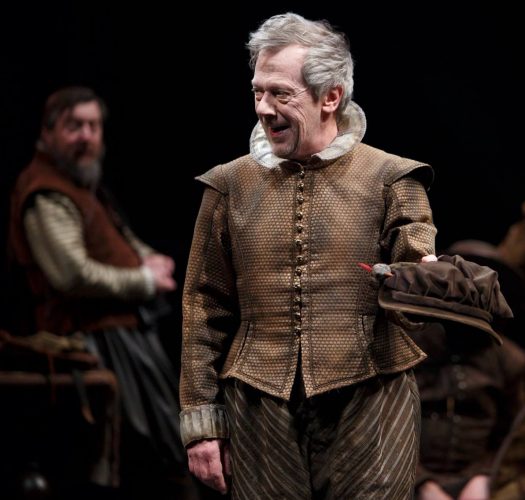
To complete the set of significant characters in Lear’s life we find the Fool, who while not necessarily important to the play, is certainly important to Lear. The Fool takes on an allegorical role similar to that of a child or beloved pet, and is unconditionally liked by his lord during his time on stage, always able to speak his mind and a comfort to Lear despite his choice words. This sort of action is seen when the fool jokes with Lear: “But I can tell why a snail has a house/…/why, to put ’s head in” (1.5.23-26) In the absence of Cordelia and Kent we can see Lear deteriorating, harassing servants and brooding over his rash decisions. In his capacity as a jester, the Fool is able to cheer the king enough to ground the latter in reality as well as to draw his attention to his foolishness. The Fool’s lowly position also serves to give Lear another layer of comfort: in the former’s utter lack of power of any sort, he poses no threat to Lear, removing a source of stress that Cordelia and Kent, as loyal and well meaning as they are, cannot. Through humour and this somewhat odd mechanism for calm, the Fool is able to tell Lear things others cannot and keep his mind firmly rooted.
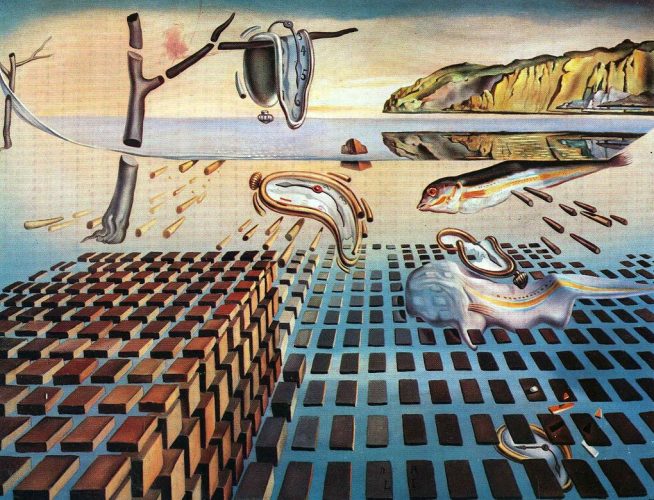
Salvador Dali’s The Disintegration Of The Persistence Of Memory nicely encapsulates the importance of the Fool to Lear. The painting is a reworking of Dali’s The Persistence Of Memory, which depicts clocks of various sorts melting over an abstract landscape. The later work depicts a breaking of the original landscape and clocks, with small, regular blocks in the foreground meant to reference the idea of all matter being made up of atoms. In his illness, Lear’s mind is much like the painting, a mess of what it once was and no longer grounded in reality. The Fool’s departure results in a full meltdown, with Lear raving at the world while his mind fragments, just as the painting does.
Art 3: Salvador Dali’s The Disintegration Of The Persistence Of Memory. (Wikimedia Commons)