Goneril and Regan
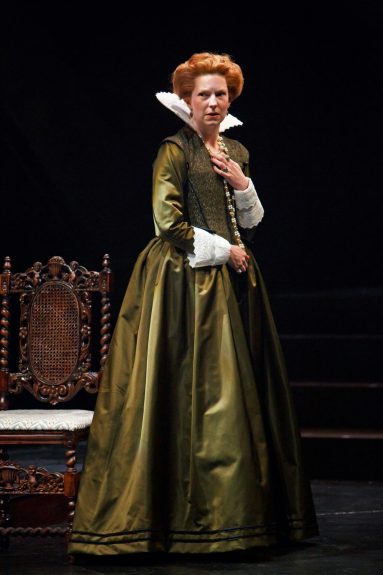
Goneril. (Stratford Productions)
Goneril and Regan play the other side of the coin, taking advantage of Lear in his weakened state rather than caring for him. Manipulating his unstable emotions at the beginning for their own gain then evicting him upon finding his behaviour tiresome, Lear’s eldest daughters have no sympathy for their father and choose to look out for themselves alone. The first hint of their intentions appears at the end of the very first scene, where Goneril notes to Regan, “You see how full of changes his age is; the observation we have made of it hath not been little … The best and soundest of his time hath been but rash; then must we look to receive from his age, not alone the imperfections of long-engraffed condition, but therewithal the unruly waywardness that infirm and choleric years bring with them” (1.1.294-300) only to come to the conclusion that they must “hit together” (1.1.304) to avoid any great inconvenience to themselves. While their callous actions may and have been interpreted as retribution for long being second to their youngest sister, their perspective is not openly meant to be empathized with. Lear’s favouritism is not intended to sway the audience’s sympathy for him or to significantly alter their perception of him as a fundamentally good man. In this way the play once again reinforces the randomness of suffering. Lear’s demise at the hands of his daughters parallels the cruelties of society and its distaste towards weakness, scorn undeserved and yet inevitable, as created by ourselves as it is unwarranted.
At the height of his madness, while wandering the moor, Lear’s mental state is in many ways well represented in Vincent van Gogh’s Self Portrait with Bandaged Ear. Van Gogh was famously mentally unstable, suffering from delusions and moments of psychosis throughout his adult life. In 1888 he cut off part of his ear, which was followed by hospitalization and a number of self-portraits depicting his bandaged head. A few years later his committed suicide, shooting himself in the chest. The two men’s stories fall in line to an extent, with a swift descent, a lull, and soon after death, but the significance of the painting lies not in that alone. While supported by family in his artistic pursuits, van Gogh never made a significant profit in his lifetime from his paintings, and ultimately pushed away everyone close in his life. He never married, although not for lack of proposing, drove away his closest friend with the fight that lead to the severing of his ear, and was only met by his brother the morning following the shot to his chest. Consciously and subconsciously rejecting aid, just as Lear does, he laid out his own end, just as Lear does.
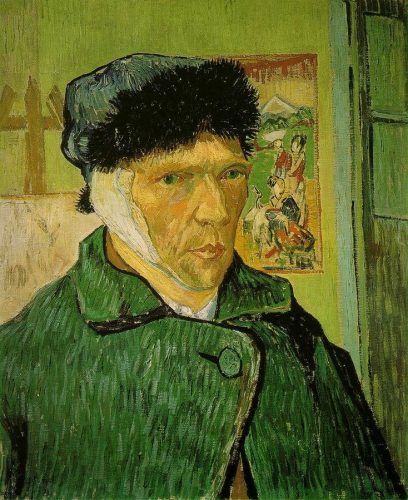
Art 2: Van Gogh’s Self Portrait With Bandaged Ear. (Wikimedia Commons)